LiveChat
  Support
Domain Meaning: What a Domain Name Really Is (and What Each TLD Signals)
When people ask about domain meaning, they are usually asking one of two things: *what is a domain name in plain terms*, or *what does a particular ending like .io or .me actually signify*. Both questions have clean, factual answers, and once you understand the underlying structure, every “X domain meaning” question becomes easy to answer for yourself.
Let me build this up from the foundation. A domain name is the human-readable address of a website — the text you type into a browser, like `example.com`. Computers do not actually find each other by these names; they find each other by numeric IP addresses such as `93.184.216.34`. A domain name is simply a friendly label that stands in for that number, so you can remember `example.com` instead of a string of digits. That substitution is the entire point of a domain, and it is the heart of what a domain *means*.
Key Takeaways
• A domain name is the readable address of a website (e.g., `example.com`) that stands in for a server’s numeric IP address.
• Every domain has an anatomy: an optional subdomain, a second-level domain (SLD) — the name you choose — and a top-level domain (TLD) — the ending like `.com`.
• A TLD is the suffix; specific TLDs carry *signals*: `.com` reads as default/commercial, `.biz` as business, `.io` as tech/startup, `.cc` as flexible/creative, `.me` as personal.
• Many “alternative” TLDs (`.io`, `.cc`, `.me`) are repurposed country codes; their modern meaning comes from convention, not geography.
• A TLD’s effect on SEO is minor; its effect on branding and trust is what actually matters.
What does a domain name actually mean?
A domain name means *a unique, readable address that points to a location on the internet*. Think of it the way you think of a street address. The physical house has coordinates (latitude and longitude), but you never use those — you use “123 Main Street” because it is easier to remember and share. A domain works identically: the website lives at an IP address, and the domain name is the easy label everyone uses to reach it.
That translation from name to number happens through the Domain Name System (DNS), which acts like a global phone book. When you type a domain, DNS looks up the matching IP address behind the scenes so your browser knows which server to contact. You can dive deeper into how that resolution and ownership works in our complete guide to how domain names work, choosing one, and owning your address.
So when someone asks “what does a domain mean,” the most accurate one-sentence answer is: a domain name is the memorable text address that stands in for a website’s numeric server location.
What are the parts of a domain name?
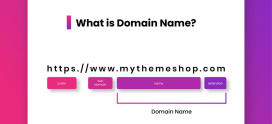
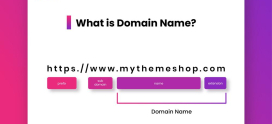
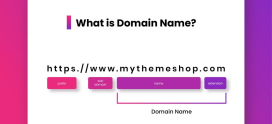
A domain is not one undivided blob of text. It is built from labeled parts, read from right to left in order of importance. Understanding the anatomy is the key that unlocks every “what does .X mean” question, because each part means something specific.
A fully expanded domain looks like this:
`subdomain.SLD.TLD`
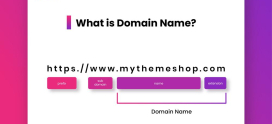
For example, in `blog.example.com`:
- `blog` is the subdomain — an optional prefix that organizes a section of the site. A lets you run separate areas (like a blog or a shop) under the same main name without buying a new domain.
- `example` is the second-level domain (SLD) — the actual name you register and the part you choose. This is your brand, your identity, the memorable word.
- `.com` is the top-level domain (TLD) — the suffix at the end that categorizes the domain.
| Part | Example | What it means |
|---|---|---|
| Subdomain | `blog.` | Optional section or sub-area of the site |
| Second-level domain (SLD) | `example` | The unique name you register — your brand |
| Top-level domain (TLD) | `.com` | The category or “ending” of the address |
The SLD plus the TLD together (`example.com`) is what people usually mean by “the domain.” The subdomain is an add-on you control after you own the domain.
What is a TLD and what does it signal?
A TLD (top-level domain) is the ending of a domain name — the part after the final dot. It is the most significant label because DNS reads domains right to left, and historically the TLD told you the *kind* of organization or *country* behind the address.
There are three broad families of TLDs:
- Generic TLDs (gTLDs) — `.com`, `.org`, `.net`, `.biz`, `.info`, and newer ones like `.app` or `.shop`. These were designed to signal a category.
- Country-code TLDs (ccTLDs) — two-letter codes assigned to countries, like `.uk` (United Kingdom), `.de` (Germany), `.ca` (Canada). These signal a national connection.
- Repurposed ccTLDs — country codes that the wider world adopted for their *sound* or *meaning* rather than their nationality, like `.io`, `.me`, and `.cc`. This is where most of the confusion about “domain meaning” comes from.
The signal a TLD sends is real, but it is a *convention*, not a technical rule. Any website can technically use almost any TLD. What matters is the association the audience has already built in their minds. Let me break down the specific ones people search for most.
What do .biz, .io, .cc, and .me domains mean?
These four are the most-searched “X domain meaning” queries after `.com`, and each one has a clear story. Here is the practical breakdown.
| TLD | Original origin | What it signals today | Best fit for |
|---|---|---|---|
| `.com` | “Commercial” (generic) | Default, trusted, universal | Almost anything; the safe default |
| `.org` | “Organization” (generic) | Nonprofits, communities, open projects | Charities, foundations, communities |
| `.net` | “Network” (generic) | Tech, infrastructure, networking | ISPs, tech utilities, fallback for `.com` |
| `.biz` | “Business” (generic) | Commerce and small business | Shops and businesses when `.com` is taken |
| `.io` | British Indian Ocean Territory (ccTLD) | Tech, software, startups, “input/output” | SaaS, dev tools, startups |
| `.cc` | Cocos (Keeling) Islands (ccTLD) | Flexible, creative, “carbon copy” | General use, creators, short brand names |
| `.me` | Montenegro (ccTLD) | Personal, “me,” portfolios | Personal sites, resumes, blogs |
Now the plain-language meaning of each query:
- .com domain meaning: `.com` originally stood for “commercial.” It is now the universal default — the ending people assume and type first. If you can get the `.com`, it carries the most built-in trust.
- .biz domain meaning: `.biz` is short for “business.” It was introduced specifically for commercial use, often chosen when the matching `.com` is already taken. It reads clearly as a business address.
- .io domain meaning: `.io` is technically the country code for the British Indian Ocean Territory, but the tech world adopted it because “I/O” means *input/output* in computing. Today it strongly signals software, SaaS, and startups.
- .cc domain meaning: `.cc` is the country code for the Cocos (Keeling) Islands, but it is sold and used globally as a flexible, short ending. People read it as “carbon copy” or simply a clean, short alternative for creative and general brands.
- .me domain meaning: `.me` is the country code for Montenegro, yet it spells the word “me,” which makes it perfect for personal sites, portfolios, and anything you want to feel individual — `about.me`, `john.me`, and similar.
Here is the part almost nobody states plainly: most of the “alternative” TLDs that feel modern and meaningful are actually country codes that got repurposed for their catchy sound. `.io` is the Indian Ocean. `.me` is Montenegro. `.cc` is the Cocos Islands. None of them were created to mean “tech,” “personal,” or “creative.” They mean those things *purely by convention* — because enough startups, designers, and developers adopted them that the association stuck. The lesson is liberating once you accept it: a TLD’s meaning today is whatever brand association people have collectively built around it, not its geographic origin. So you should choose the TLD whose *vibe* fits your brand, not the one whose history sounds official. The origin is trivia; the perception is the product.
Does the TLD affect SEO or trust?
Let me give you the honest, structured answer, because there is a lot of myth here.
On SEO: The TLD has a minor direct effect, with one notable nuance. Search engines do not rank `.com` higher than `.io` or `.biz` simply because of the ending — the major engines have stated that generic TLDs are treated neutrally. The one real exception is country-code TLDs: a `.de` or `.co.uk` can signal to search engines that the site targets a specific country, which helps for local results in that country but can hold you back globally. For most generic and repurposed TLDs, ranking comes down to your content, links, and site quality — not the suffix.
On trust: This is where the TLD genuinely matters, and it is human, not algorithmic. People have learned to expect `.com`, so an unfamiliar ending can cause a split second of hesitation for a cautious audience. That said, audiences in tech happily trust `.io`, creative audiences accept `.cc` and `.me`, and businesses recognize `.biz`. Trust is contextual: the “right” TLD is the one your specific audience already associates with credible sites in your space.
So the practical takeaway is this: choose a TLD for branding and audience fit first, and treat SEO as a near-neutral factor — except when you are deliberately targeting one country, in which case a matching ccTLD can help locally.
How do you choose a TLD by meaning and brand fit?
Because a TLD’s meaning is built on convention, choosing one is really an exercise in matching the convention to your brand. Here is a methodical way to decide.
- Try for the `.com` first. It carries the broadest trust and is what people type by default. If your exact name is available in `.com`, that is usually the strongest choice.
- If `.com` is taken, match the TLD to your category. A startup or dev tool fits `.io`. A personal portfolio fits `.me`. A straightforward business fits `.biz`. A nonprofit fits `.org`.
- Use a repurposed TLD when it makes the name read better. Sometimes the ending completes the word or concept — that is a feature, not a compromise.
- Target a ccTLD only if you serve one country. If your audience is national, a `.de` or `.ca` signals local relevance and can help in that market.
- Check that the SLD stays clear. The name you choose — the step — matters more than the ending. A clear, short, spellable name with a “wrong” TLD beats a confusing name with the perfect one.
If you want the full menu of endings and what each is built for, our overview of walks through generic, sponsored, and country-code options in detail.
Domain meaning vs hosting vs URL: what’s the difference?
People mix these three terms constantly, so let me separate them cleanly, because they mean genuinely different things.
| Term | What it means | Analogy |
|---|---|---|
| Domain name | The readable address (`example.com`) | The street address |
| Web hosting | The server space where your site’s files live | The actual house/land |
| URL | The full path to a specific page (`https://example.com/blog/post`) | Address plus the room inside |
- A domain is just the name — the label that points to a server.
- Hosting is the storage and computing power that *holds* your website. You can own a domain with no hosting (it just won’t show a site), and you can have hosting without a custom domain. They are separate purchases that work together.
- A URL (Uniform Resource Locator) is the complete address of a specific resource. It includes the protocol (`https://`), the domain (`example.com`), and the path to a page (`/blog/post`). The domain is one *part* of the URL.
So: the domain *means* the name, hosting *means* the space, and the URL *means* the full address to one page. Keep those distinct and most domain confusion disappears.
Register your domain with DarazHost
Once you understand what a domain means, the next step is owning the right one. DarazHost registers domains across many TLDs — `.com`, `.biz`, `.io`, `.me`, `.cc`, country codes, and more — with transparent registration and renewal pricing so there are no surprises at renewal time. Every domain includes free WHOIS privacy to keep your personal details off public records, plus easy DNS management so you can point your name wherever you need. Because DarazHost offers domains, hosting, and email together, you can pick a name, attach a site, and set up matching email addresses in one place — with 24/7 support to help you choose and configure the right name for your brand.
Frequently asked questions about domain meaning
What does a domain name mean in simple terms? A domain name is the readable address of a website, like `example.com`. It stands in for the server’s numeric IP address so people can reach the site with an easy-to-remember name instead of a string of numbers.
What does the .io domain mean? `.io` is technically the country code for the British Indian Ocean Territory, but it was adopted by the tech industry because “I/O” means input/output in computing. Today it signals software, startups, and SaaS products — its meaning comes from convention, not geography.
What does a .me domain mean? `.me` is the country code for Montenegro, but because it spells the word “me,” it is widely used for personal websites, portfolios, and resumes. It is the go-to ending when you want a domain to feel individual and personal.
Is a .com domain better than .biz, .io, or .cc? `.com` carries the most universal trust and is the default people type, so it is usually the safest choice. But `.biz`, `.io`, and `.cc` are perfectly valid — search engines treat generic TLDs neutrally, so the better choice is the one whose meaning fits your brand and audience.
Does the domain ending affect SEO? For generic TLDs, the effect is minor — rankings depend on content, links, and quality, not the suffix. The exception is country-code TLDs, which can signal that a site targets a specific country and help with local results there.